
Rogue Train Kiln Firing Plan 1.5
Preparation before firing
Have two bays of wood split for side stoking, one bay of wood split relatively small for feeding the bottom door for the start, and other bays with wood for the top door that is about 20″ long up to 7″ in diameter.
Arrange the shifts to have just a couple people for the first half, then 4-5 people for the later shifts where it gets busier because of side stoking. Sealing up the kiln at the end is a massive job, good to have 5 people for that if possible.
When loading, label cones and make sure they are visible. Have a recording sheet for them. Be protective of the pieces along the stoke alley. Have three ranks in front, two in back and leave the rest of the space for the alley. Wadding on the posts dries out quickly, so put it on both sides of the posts and immediately put the shelf on top. Load some oak in the firing alley so it can smolder and ignite as the fire builds.
Fire up the generator and splitter to make sure they’re working if needed. Fill them with gas.
Candling
Air: Two bottom ports open
Damper: Open
Temp range: 0-180F
Use the propane burner fed through a bottom air port to candle overnight. It won’t get over 200F but that’s fine.
Starting bottom fire
Air: Two bottom ports open
Damper: Open
Temp range: 00-1000F
Start a small fire in the bottom by placing some kindling on top of the propane burner. Feed with smaller wood, shut down and remove propane burner when the fire is self-sustaining. Aim for 50/hr rise, going faster can stress the front pots and cause cracks and warpage.
As the temperature increases, it gets harder to fit more wood in the bottom. Try shifting the coals around by poking through the air holes and the door. It that isn’t helping, start the process of shifting to the grate earlier than 1000F.
If the temperature won’t rise:
- Rake the coals and push them toward the back too.
- Try putting in smaller softer wood (pine or fir) which will burn faster.
- Possibly open another lower air port hole to get heat from the embers.
Preparing to shift to grate
Air: Two bottom ports open
Damper: Open
Temp range: ~1000F
Open the top middle air hole for at least 15 minutes to help heat up the top of the Bourry box before putting wood on the grate.
Shifting to grate
Air: Two bottom ports & top middle port open
Damper: Open
Temp range: 1000F
Put one medium piece of fir on the grate. If it doesn’t burn immediately, then wait another half hour and try again while continuing to feed the bottom. For the next hour you’ll be feeding both the top and bottom as you transition.
Getting for body reduction
Air: Two bottom ports & top middle port open
Damper: Open
Temp range: 1000-1582 (Cone 012)F
At this stage, a total of 3 open air holes should be plenty. Two top holes are good for circulation, a lower hole is useful to have open so that you can poke rebar in to redistribute the logs.
Start checking the cones when pyrometer reads 1200F.
When feeding the top, place fir logs in a layer across the grate and then larger fir and oak logs on top. We don’t want newly added logs to fall through the grate. Be careful to never let coal bed build up enough to block the throat. If the throat is blocked by coals, ream and open lower air holes to lower the coal bed so that it’s no longer blocking the throat.
Every half hour ream the coal beds to redistribute the coals. Work from the top holes down.
If the temperature rise stalls, check the following:
- Check chimney airflow, you should be able to see through the screen. If smoke is coming out of everywhere the chimney may be blocked or the dampers are in too far
- Check the coal bed, rake charcoal out.
- Feeding pattern: try fir for a while, smaller wood too.
- Shift the wood around to let embers fall through the grate.
- Check the air holes, try different patterns.
- Maybe start using the stoke alley.
- Possibly open the dampers if it is in too much reduction.
Body reduction
Air: Two bottom ports & top middle port open
Damper: Closed to 40%?
Temp range: Cone 012 (1582F) – Cone 05 (1888F)
When ^012 (1582F) in front goes down, go into body reduction by restricting the air intake and closing the damper. This will stall the temperature rise and produce smoke. We do need it to keep rising until ^05 (1888F) is down everywere, so allow enough air flow for that. It may be necessary to side stoke to help this happen.
Finishing body reduction to cone 8
Air: Two bottom ports & top middle port open, more as needed
Damper: Closed to 40%?
Temp range: Cone 05 (1888F) – Cone 8 ()
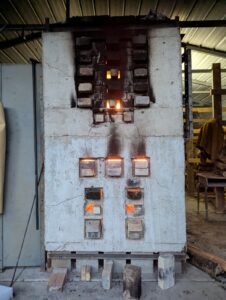
Can increase temp rise to 100F/hr. If you haven’t started side stoking yet, then when the front hits 1900F, start side stoking to even out temperature front to back. Gently add kindling through the side stoking ports by hand or with a push stick. Side stoke first, then feed Bourry Box. Opening the side stoke bottom ports by only 1/4 brick can be enough to help the stoke alley burn down its fuel and raise the temperature in the back.
Raking the coals on the top grate helps it clear holes for airflow. We rake the coals through the front ports once or twice between stoking.
Try to keep the heat balanced left to right by observing through a middle front brick and raking the coals on the floor side to side to even them out. Keep some air coming in from the bottom ports to help get heat lower in the kiln.
Targeting a pyrometer peak of 2100F was enough to get cone 8 moving.
Here’s an example of how the ports might look:
Cone 8 down, getting to cone 10
Air: Two bottom ports & top middle port open, more as needed
Damper: Closed to 40%?
Temp range: Cone 8 (2277F) – Cone 10
When cone 8 goes down in front, note that temperature. The goal is to stay at that temperature and below until the end of the firing. Feeding wood will drop the temperature. When the temperature rises to the target, feed again. Cone 10 should go down during this process. Continue to side stoke as needed. In general we want to keep it between 2100F and 2400F
After ^9 is down in front, feed the back more than you feed the front. Close air up front and just barely feed the front. Don’t take it any higher. Concentrate on evening out the kiln temperature.
The aim is to keep the front of the kiln between 2000F-2300F while feeding the back. If it drops below that start feeding the front again.
Shutting down
Air: Everything closed and sealed
Damper: Closed
Temp range: Cone 10 and down
Once cone 10 is down in front, do a big stoke and put the dampers in half way to let them warm up. Plug everything, open the passive damper, put the bricks in the doorways and seal up all cracks with wadding. Then push the dampers all the way in and seal their bottom edge.